
Jewelry plating cost depends on what is deposited, how much surface is coated, the specified thickness and the preparation and protection required. A gold or silver color alone does not identify the finish. Choose a suitable specification for your collection; a higher-cost coating is not automatically necessary for every product.
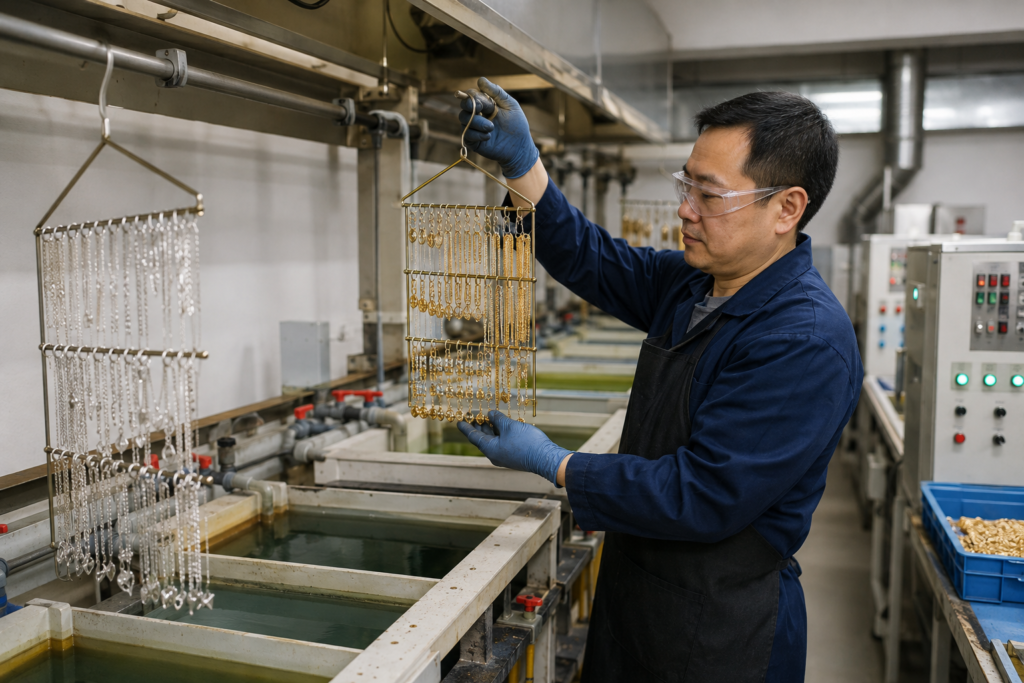
Two pieces can look the same colour and still have different plating costs. A useful comparison starts with the base material, coating metal, thickness, preparation, protective finish and quantity. For OEM and private label jewellery, buyers should also align the ordering unit, sample requirements and packaging before comparing the final unit price.
What should you compare before choosing a quotation?
Start with a written specification that every supplier can quote against. A product photograph is useful for design and colour direction, but it does not establish the coating composition, thickness or production requirements.
Use the same style, dimensions, quantity per colour and packaging basis for each quotation. If a detail is open, ask the supplier to identify the proposed option clearly. A low price based on a different specification is a different offer, rather than a like-for-like saving.
| Quote detail | What the buyer should ask for | Why it matters |
|---|---|---|
| Base material | Main body and separate components, including posts, chains and clasps | Different materials and components may require different preparation and finishes |
| Coating | Actual deposited material and finishing process | A colour name does not establish the coating composition |
| Thickness | Target thickness in micrometres, where applicable, and how it will be checked | The amount of deposited material and verification requirements affect the specification |
| Preparation and protection | Polishing requirements, relevant underlayers and any protective coating | The visible colour is only one part of the finishing system |
| Quantity and unit | Quantity per style and colour; price per piece, pair or complete set | Different units can make apparently similar prices incomparable |
| Sample approval | What must be approved and which revisions remain open | The reference needs to match the intended production requirements |
| Packing and delivery | Included packaging, separately quoted items and transport basis | Product price alone may not represent the complete purchasing cost |
Does “gold tone” mean genuine gold plating?
“Gold tone” describes appearance. It does not, by itself, establish that the finish contains gold or identify its thickness. “Silver tone” is similarly a colour description rather than confirmation of silver plating.
When a quotation specifies genuine gold plating, confirm the deposited material and thickness separately from the colour reference. If the supplier offers another gold-coloured finish, ask for its actual specification. Do not treat a photograph, a colour name or a coating-process name as proof of precious-metal content.
The same discipline applies to the underlying product. Brass, copper and stainless steel should not be treated as interchangeable catalogue labels. Confirm the material for the selected style and its individual components before approving the quote.
How do thickness and product size affect jewelry plating cost?
For an otherwise comparable precious-metal coating, more deposited metal means more material is used. Thickness therefore matters, but it needs to be considered alongside the surface being coated and the complete production specification.
A wider product, a different construction or additional separate components may change the coating requirement. Product weight alone is not a reliable substitute for coated surface area. Two styles should not be assumed to have the same finishing cost simply because their weights or colours look similar.
Ask how thickness will be specified and verified if it is an important buying requirement. Instrument manufacturer Helmut Fischer describes X-ray fluorescence measurement of layer composition and thickness for fashion-jewellery coating systems. That is an example of a measurement approach, not evidence that every supplier owns the equipment or tests every item. The agreed method and reporting scope should be discussed for the actual project.
Is thicker plating always the right choice?
Choose a finishing specification for the product and intended use. Thickness alone does not establish a finished product’s wear life, and it does not replace appropriate preparation, assembly or handling.
Discuss the appearance you need, expected wear, care guidance, target retail positioning and any testing requirements. If a performance statement will appear in your product marketing, decide what evidence is needed before making that statement. A colour reference or sample photograph does not establish claims such as waterproof performance or a fixed period without colour change.
For a closer look at visible surface issues, read our guide to surface defects and jewelry plating quality.
How should brass electroplating and stainless steel finishes be compared?
Compare complete product proposals. KMJ supports brass and stainless steel jewellery projects, with finishing requirements reviewed for the selected design. The suitable material and process should be discussed together rather than selected from colour alone.
For brass projects, useful questions include the requested plating metal, colour, thickness and protective e-coating. For stainless steel, confirm the actual grade and component materials, as well as whether the quoted finish uses PVD, another treatment or the polished base surface. Do not assume that every stainless steel style is 316L or that every gold-coloured PVD finish has the same composition.
Resin-led collections need their own specification: confirm the resin components, colour reference and any separate metal findings. A plating specification for a metal component should not be applied automatically to the resin part.
Can the catalogue help you prepare a more precise enquiry?
Use the product code to identify a starting point, then separate the details already listed from the decisions still needed for your order. These examples come from KMJ’s current catalogue; they are product references, not comparative price offers.
| Catalogue reference | Published starting point | Decision to resolve before quotation approval |
|---|---|---|
| KMJ-NE-0151, asymmetric pearl-look chain necklace | Brass components, gold-tone appearance, 42.5 cm length plus 6 cm extension; reference MOQ 200 pcs per colour | Confirm the final plating specification, bead material, measurement basis and order requirements |
| KMJ-MR-1301, men’s brown-accent open ring | Stainless steel components and a silver-tone appearance with a brown accent; MOQ quoted separately | Confirm steel grade, centre material, ring size and whether a coating is required |
A reference MOQ is not a universal minimum for every material or customisation. For earrings and coordinated sets, state explicitly how the order and price are counted. Logo work and packaging may have separate requirements.
What belongs in a useful quotation request?
Send a short brief that makes the commercial requirement clear:
- The KMJ product code or a design reference you are authorised to share.
- Base material and any components that must meet a particular specification.
- Target colour and any required coating metal, thickness or protective finish.
- Quantity for each style and each colour, with pieces, pairs or sets stated clearly.
- Required dimensions, sizing system and the details to be confirmed in the sample.
- Branding, product cards, labels, pouches or boxes to include in the quotation.
- Destination market, target arrival date and target purchasing budget or price range.
If you have not decided on a finish, describe the appearance, intended use and target price instead. Ask for separately identified options so you can see which specification each quotation covers.
For the broader development process, use our jewelry manufacturing guide for brands.
What should be approved before bulk production?
Record the agreed product, dimensions, finish, fittings and packaging, alongside any revisions to the sample. Keep the approved reference and written specification together so that colour approval is not mistaken for approval of every other detail.
KMJ’s published reference is typically 10–15 days for sampling after specifications are confirmed, and 35–45 days for bulk production after sample approval and deposit. These are planning references, subject to the actual style, quantity, packaging, revisions and schedule. Shipping is additional, so a production completion date should not be treated as an arrival date in Australia, New Zealand or another destination.
Where inspection or testing is needed, agree its scope, acceptance criteria, timing and any separate costs before committing to a delivery plan. No general coating description should be treated as a product-specific test report.
Frequently asked questions
Why are two gold-tone quotations different?
They may cover different base materials, deposited coatings, thicknesses, preparation, protection, quantities or packing. Ask for those details on the same basis before comparing unit prices.
Can I approve the finish from a product photo?
A photo can communicate design and colour direction. It cannot confirm coating composition, thickness or wear performance. Agree the written specification and sample approval requirements for your order.
Does a silver-tone finish mean the product is silver plated?
No. Silver tone describes colour. Ask whether the proposal is a polished base surface or a coating, and request the actual coating material if one is specified.
Is the MOQ the same for every material and style?
No. Confirm the selected product, material, colour and customisation. KMJ publishes 200 pieces per colour as a reference for custom brass projects, while other requirements are quoted separately. Do not automatically convert pieces to pairs or complete sets.
Can private label packaging be included?
KMJ supports discussions about product cards, pouches, boxes and labels. Specify which items you need and ask for their quantities, costs and lead times to be identified in the quotation. Packaging requirements are confirmed for the order.
What should I send if I do not know the right thickness?
Share the product reference, preferred material, target colour, intended use, quantity and target price. Identify thickness as a decision to discuss. A proposed option should be confirmed in writing before sample or production approval.
Request a quote for your collection
Planning an OEM or private label jewellery range? Send the product reference or SKU, quantity per style and colour, preferred material, finish requirements and target arrival date. KMJ can review the brief and identify the specifications to confirm before sampling.
Technical reference: Helmut Fischer — measurement of precious metals and fashion-jewellery coating systems. This reference explains measurement technology; it does not certify KMJ products or establish KMJ’s equipment or testing scope.